NASA hosted a public meeting on Unidentified Anomalous Phenomena (UAP) on May 31, 2023. A number of presentations were made by a diverse group of scientists organized by NASA to study UAP.
Spherical Objects
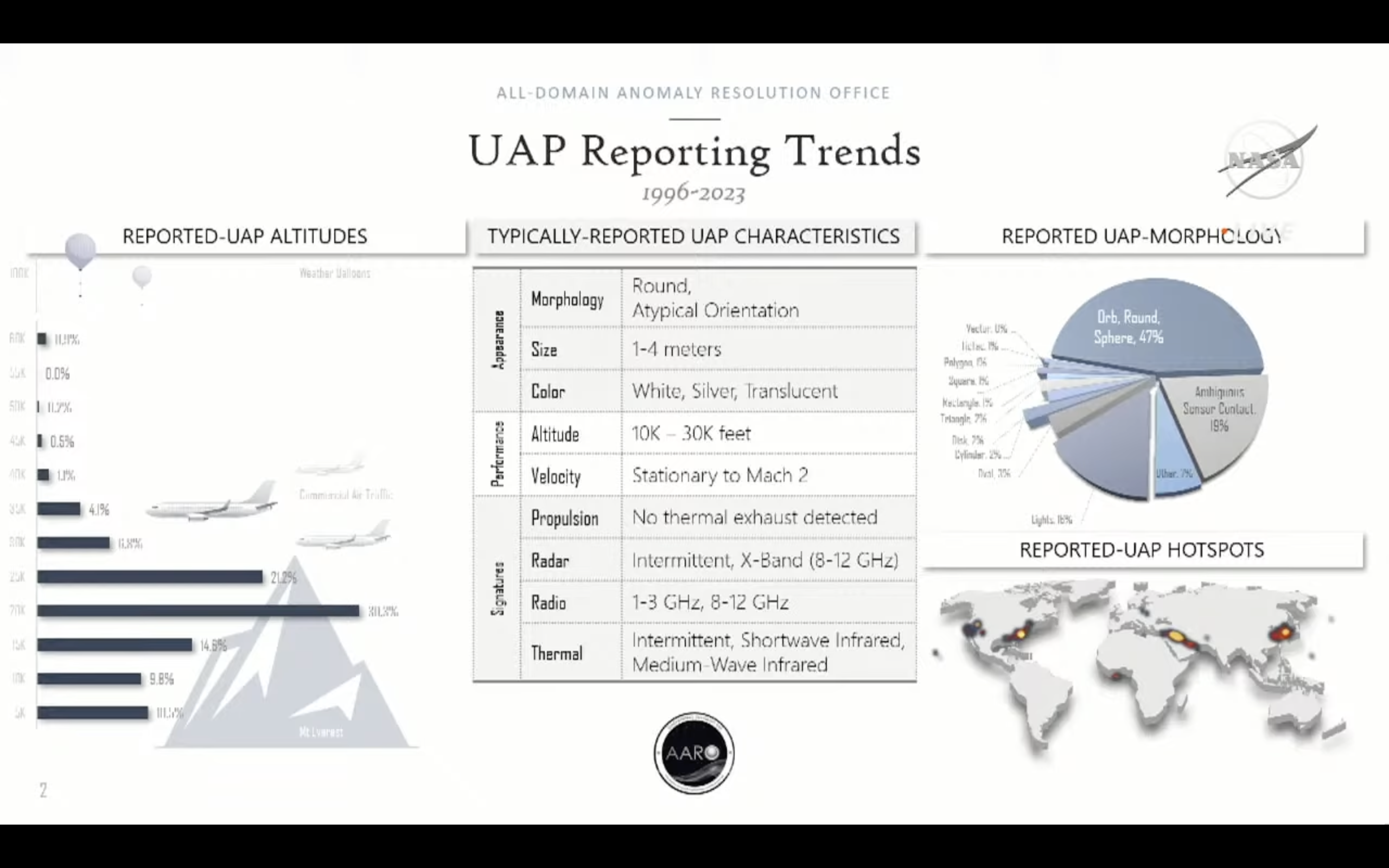
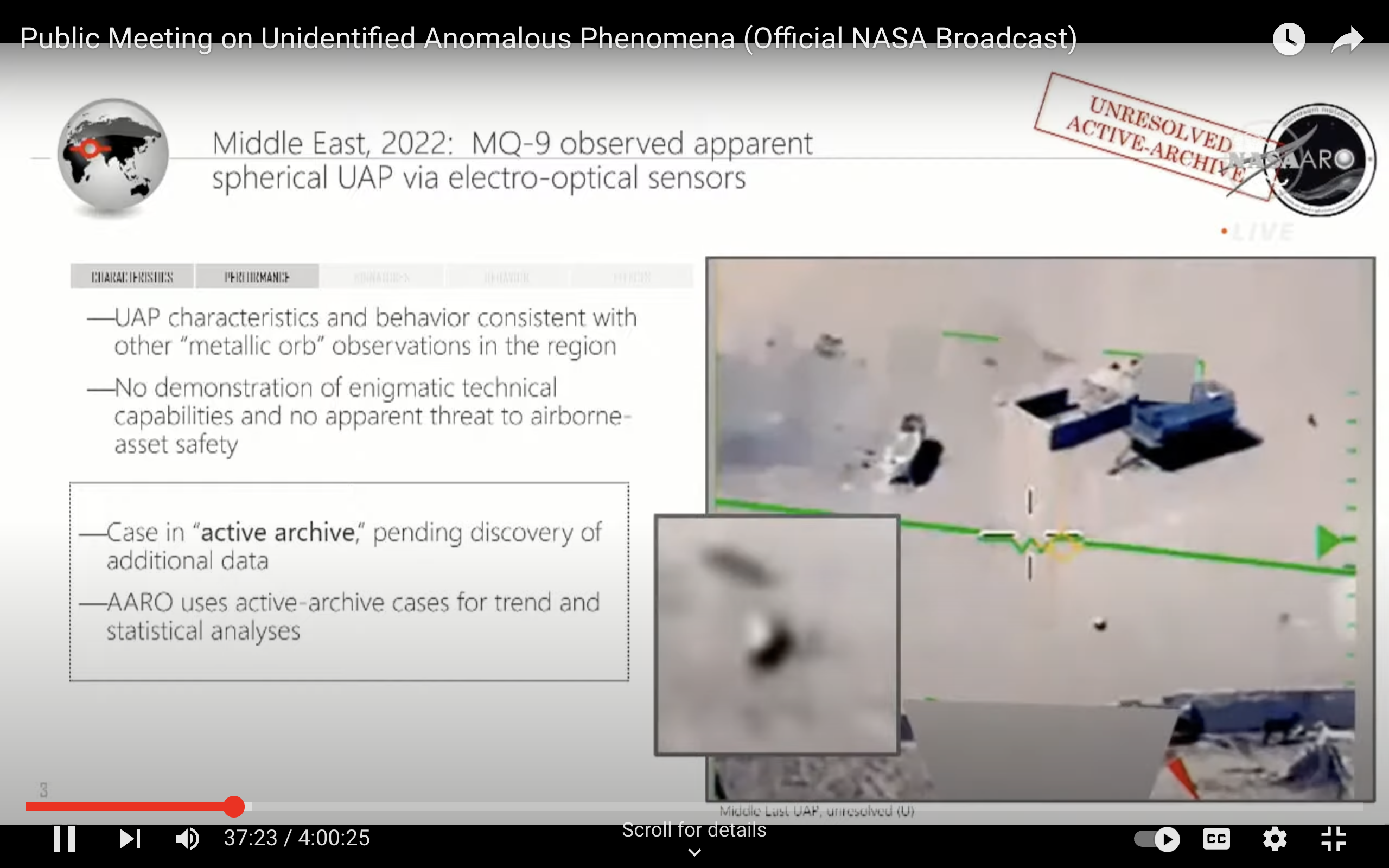
Perhaps the most informative was a briefing by Sean Kirkpatrick, director of DoD’s All-domain Anomaly Resolution Office (AARO) who summarized early findings from approximately 800 UAP reports. Consistent with information provided by the National UFO Reporting Center (NUFORC), the majority (slightly more than 50%) of recent sightings are of spherical objects. He estimated that only 2-5% of the reported objects appeared to be anomalous. The search for spherical objects exhibiting anomalous flight and other signature characteristics appears to be their main priority.
A briefing by FAA described the use of civilian radars to detect and track anomalous objects. It was suggested that the data could be used to correlate ground-based reports with unknown aircraft in the area. That said, it is noted that some objects such as the UFO tracked by the Chilean Navy in 2014 did not show up on radar.
AARO looking just for spherical objects behaving in anomalous ways is a start but may be too restrictive in scope over the long term. With so many other shapes reported one has to wonder about them. If we only address spherical objects and determine that most are not behaving in anomalous ways, have we then solved UAP, at least as a practical problem (i.e., air safety and national security)? A divide and conquer strategy can reduce a complex problem to more easily analyzable sub-problems but if it does so to the point where the essence of the phenomenon is lost (e.g., reducing the mystery of life to a bunch of biochemical processes) then it will not serve the true purpose of science – which is, to know.
Defining (Controlling?) the Paradigm
Over the course of the four-hour-long video, we begin to develop a sense of what NASA’s role and influence will be from here on out. Stated repeatedly was the need to develop a “roadmap” to guide future work. A framework for UAP was presented based on three key points: 1) there is no evidence UAP are extraterrestrial, 2) UAP studies represent a good problem for science, and 3) in the process of studying UAP (after we figure out what we are looking for), we may learn new things about our planet.
The panel seems to have a hard time defining what is anomalous. One has to wonder what’s wrong with Luis Elizondo’s list of five observables. This reminds of me the “not-invented-here syndrome” – a tendency for people and organizations to avoid things that they didn’t create themselves. NASA is often accused of this believing that they can formulate and solve a problem in a better way than others can.
I have to say that watching the chat comments as this presentation was unfolding was not flattering to NASA. One has to expect the usual spam comments but the number of people unimpressed by some of the presentations was more than what one would expect. There remains a great divide between the public and the scientific community on UFOs and UAP.
Stated at the outset and repeated many times during the event was NASA’s desire to remove the stigma associated with UFO/UAP research. Ironically and even somewhat hypocritically NASA and the mainstream scientific community (e.g., Condon report, Roberson panel, Brookings, etc.) were largely responsible for that stigma in the first place.
What I found most interesting was learning that NASA’s main interest appears to be in shaping the scientific problem. This defines everything from the kinds of data that can be used, to methods and even the types of hypotheses/theories considered to be acceptable by this new community. And that planetary scientists are doing the “shaping” is especially troubling. The search for extraterrestrial intelligence (SETI) by radio and related means as well as the search for primitive life on the planets have turned up no evidence for either. Will this also be true for NASA’s UAP investigation group?
Beggars Can’t Be Choosers
A recurring theme is the need for “calibrated” datasets, which NASA claims are few and far between. They state the biggest obstacle is the lack of high-quality data. With hundreds of thousands of reports in the NUFORC database, dozens of cell phone videos of strange phenomena captured each day, and other data from a variety of “uncalibrated” sources becoming available, this obstacle would seem to be self-imposed. We are not studying a celestial object that is there every time we turn our telescope on it but an elusive phenomenon that we have little if any control over. In fact the transient nature of UAP sightings would make calibrated collections using multiple sources (one of NASA’s stated requirements) next to impossible. A practical approach to the problem should include the ability to use all available data/metadata employing methods that can handle and quantify uncertainty (e.g., Bayesian inference)
One of the presentations seemed to dismiss the Navy GO-FAST Tic Tac encounter based on just the video footage without considering other similar videos in the context of the overall event, which was corroborated with radar reports of UAP jumping from low earth orbit to aircraft altitudes in seconds.
It was interesting to learn that there are no space or maritime reports. A member of the panel, astronaut Scott Kelly said that everything that seemed unusual that he’s seen in space has turned out to be some kind of optical illusion, or seeing familiar objects in unfamiliar circumstances. That AARO has no space or maritime reports may be the result of either not looking or simply not reporting.
NASA’s high data standards may be so high as to render most data unsuitable for analysis. And without sufficient data, the problem will remain unresolved. It was also stated that the extraordinary evidence needed to support an extraordinary claim (that UAPs are real?) does not yet exist. Again an overly high standard of evidence may be counter-productive to the investigation.
The use of crowd-sourced data was also mentioned several times, including the development of special apps and UAP reporting protocols. Given the above, it will be interesting to see how NASA uses such data.
More Than Just a Physical Phenomenon
Physical scientists do what physical scientists do. Understandably, the focus of this meeting is on understanding the phenomenon from a physical perspective. At no time was there any discussion about patterns, intent, or purpose. These are some of the hidden variables that we may be able to infer by a detailed analysis of UAP report data. This alternate strategy, which I discuss in my book Not of This World, assumes that if we are being observed in a manner beyond our control our only recourse may be to observe the observer. Although this does not solve the scientific question regarding the nature of UAP it addresses a social question that may become even more important if, in the coming years, NASA and DoD are unable to at least begin to develop an understanding of the physical phenomenon itself.
 Not of This World
Great blog! Insights are excellent. I applaud using crowd spurced qualitative data and observe the observer approach. Tuned in to the last half of the public hearing and was astonished they were still debating a definition for Anomalous and were discounting the thousands of credible reports by NUFORC and MUFON databases.
LikeLiked by 1 person
NASA has so narrowed the study parameters that a vast percentage of data will be ignored. Were the Navy and the US Gov. watching for a ground invasion of
Pearl Harbor? This seems to be the same mindset.
LikeLiked by 1 person
What influence did the Seance, at JPL, 1946, with L Ron Hubbard, and others, have? My grandmother, Alice Hodgins attended. Never heard the story.
Respectfully, submitted
LikeLike
An interesting connection. Makes one wonder…
LikeLike
Sylvia Ault
LikeLike
UFO’s arde demonic, that’s why is Nasa silent on it.
LikeLike